

Tax Implications of Home Renovation: What You Can and Can’t Deduct
DECEMBER 01, 2025

The spreadsheet stares back at you. Three columns: item, budget option, premium option. The price differences are staggering. The basic laminate countertop costs $2,400 installed. The quartz version costs $7,800. The builder-grade flooring runs $4,200. The premium hardwood comes in at $14,500. Multiply these decisions across dozens of line items in a renovation, and the gap between "budget build" and "dream build" stretches into tens of thousands of dollars.
This is the moment where renovations go wrong. Not from choosing badly in any single category, but from choosing inconsistently—splurging on visible upgrades that deliver limited functional value while skimping on hidden elements that determine whether the renovation still looks good and functions well in year eight. The bathroom with the gorgeous marble countertop that eternally shows water spots. The kitchen with premium appliances installed on subfloor that squeaks with every step. The exterior with beautiful siding over inadequate moisture barrier that's rotting from within.
The splurge-versus-save decision isn't really about money, though money constrains options. It's about understanding which investments deliver returns—in durability, in maintenance reduction, in daily satisfaction, in resale value—and which investments are essentially consumption that provides momentary pleasure but depreciating value.
The difficulty is that the renovation industry, design media, and even well-meaning friends often guide these decisions backward. Visual impact gets prioritized over structural integrity. Trend-driven choices get prioritized over timeless durability. The elements that photograph well get budgeted generously while the elements that determine whether the renovation still performs well a decade from now get value-engineered into inadequacy.
This article provides a framework for making splurge-versus-save decisions based on evidence rather than emotion. By the end, you'll understand which material categories reward premium investment with meaningfully better outcomes, which categories offer diminishing returns at premium price points, and how to allocate a finite renovation budget to maximize both immediate satisfaction and long-term value.

The price you pay at purchase represents only the beginning of what a material will cost you. Lifecycle cost analysis—a concept that HUD research has applied to housing materials extensively—considers the total cost of ownership over the useful life of a material: purchase price, installation cost, maintenance costs, repair costs, and eventual replacement cost.
This analysis frequently inverts the apparent economics of material choices. A flooring material that costs 40% less to install but lasts half as long and requires twice-annual maintenance actually costs more over a twenty-year ownership period than the premium alternative. A roofing material that saves $4,000 initially but requires replacement in fifteen years rather than thirty costs more than the premium option over the ownership period—and involves the disruption and risk of a second installation.
The mathematics of lifecycle cost compound in ways that aren't intuitive. Consider a simplified example: Material A costs $5,000 installed with a twenty-year lifespan and $100 annual maintenance. Material B costs $3,000 installed with a ten-year lifespan and $200 annual maintenance. Over twenty years, Material A costs $7,000 total ($5,000 + 20 × $100). Material B costs $10,000 total ($3,000 + $3,000 replacement + 20 × $200). The budget option costs 43% more over the ownership period despite costing 40% less at purchase.
Real materials aren't this simple—lifespans vary based on conditions, maintenance requirements aren't perfectly predictable, and replacement timing involves choices about whether to replace at end of optimal life or push further. But the principle holds: apparent savings at purchase often transform into real costs over ownership periods.
The National Association of Home Builders (NAHB) publishes research on material life expectancy that provides crucial inputs for lifecycle calculations. Their data reveals enormous variation in expected lifespans across material categories and quality levels—variation that purchase price alone doesn't fully signal.
Short-term savings leading to expensive repair cycles represents the most common budget renovation failure mode. The homeowner who saved $2,000 by choosing lesser-quality window installation finds themselves paying $5,000 to remediate water damage and reinstall properly. The homeowner who saved $800 on bathroom waterproofing discovers the cost of demolishing and rebuilding when moisture penetrates substrate. These aren't hypotheticals—they're patterns that contractors observe repeatedly in homes where budget decisions were made without lifecycle perspective.
Before examining specific material categories, understanding why homeowners systematically make certain decision errors helps guard against those errors. The psychological forces that shape renovation decisions don't always align with rational value maximization.
Visual impact dominates human attention in ways that distort material priorities. We respond to what we can see—the dramatic backsplash, the statement light fixture, the eye-catching countertop. We respond weakly to what we can't see—the moisture barrier behind the tile, the subfloor under the hardwood, the insulation in the walls. This visibility bias leads to overspending on surfaces and underspending on substrates, producing renovations that photograph beautifully but underperform structurally.
Understanding these psychological patterns doesn't automatically overcome them, but it enables deliberate correction. When you notice yourself drawn to splurge on a visible element while reluctant to spend on a hidden element, that's the moment to pause and ask whether visibility bias is distorting your priorities.
Certain material categories consistently reward premium investment with meaningfully better outcomes. Understanding which categories these are enables strategic budget allocation that concentrates spending where it delivers the greatest return.
High-traffic flooring represents perhaps the clearest case for premium investment. Floors experience more wear than any other surface in a home—foot traffic, furniture movement, dropped objects, pet activity, cleaning abrasion. Budget flooring in high-traffic areas shows wear within years; premium flooring in the same areas can last decades.
The performance gap between budget and premium flooring isn't linear with price. A flooring product that costs 60% more than the budget option may last three times as long under equivalent use. The ASTM International standards for flooring durability testing measure resistance to wear, indentation, moisture, and other stressors that determine real-world lifespan. Products that meet higher ASTM performance thresholds typically—though not universally—correspond to higher price points.
For hardwood flooring specifically, the thickness of the wear layer determines how many times the floor can be refinished and thus how long it can serve before replacement becomes necessary. Solid hardwood with thick wear layers can be refinished multiple times over a fifty-year-plus lifespan. Thin engineered products may allow one refinishing or none. The apparent savings of thinner products evaporates over ownership periods long enough to require refinishing.
Exterior moisture barriers and insulation represent high-stakes invisible investments where premium quality prevents catastrophic failures that budget quality permits. Water intrusion through inadequate exterior barriers causes structural damage, mold growth, and cascading repair costs that dwarf any savings from the cheaper barrier. The homeowner can't see the moisture barrier once it's installed, but they'll see the consequences of barrier failure in damaged framing, stained drywall, and remediation invoices.
The Harvard Joint Center for Housing Studies has documented how building envelope failures drive unexpected renovation costs. Moisture management failures in particular generate repair costs that typically run ten to fifty times what adequate moisture protection would have cost initially.
Cabinet hardware—hinges, drawer slides, door mechanisms—illustrates how functional components within larger assemblies warrant premium investment even when the assembly itself may be mid-tier. Cabinets experience thousands of open-close cycles per year. Budget hinges and slides fail, become noisy, or allow doors and drawers to sag. Premium soft-close hinges and full-extension drawer slides cost perhaps $30-50 more per opening but transform daily cabinet use from tolerable to pleasant, and maintain smooth operation for decades rather than years.
The quartz versus laminate countertop comparison illustrates the splurge case in heavy-use applications. Laminate countertops have improved dramatically and serve adequately in light-use settings. But in heavy-use kitchens—families who cook daily, entertain regularly, and put their counters through demanding service—laminate shows wear that quartz resists. Laminate edges chip. Laminate surfaces can burn, scratch, and delaminate at seams. Quartz resists essentially all of this abuse indefinitely. The price premium of three to four times for quartz delivers proportionally greater durability in high-use contexts.
Window and door quality affects both durability and ongoing energy costs. Premium windows with better thermal performance, superior weatherstripping, and more durable hardware reduce energy costs annually while lasting longer before requiring replacement. The NAHB material longevity data shows quality windows lasting thirty to fifty years versus fifteen to twenty for economy windows—a lifespan differential that, combined with energy savings, often favors premium investment.
Plumbing fixtures in water-intensive applications reward quality investment. Faucets, shower valves, and toilet mechanisms experience constant water exposure and mechanical cycling. Budget fixtures develop leaks, lose finish, and require replacement within years. Quality fixtures from established manufacturers include better internal components, more durable finishes, and typically better warranty coverage that protects the investment.
Equally important to knowing where to splurge is knowing where savings come without meaningful quality sacrifice. Some material categories offer minimal performance differentiation across price points; others present premium options that deliver primarily aesthetic rather than functional advantages.
Paint finish comparisons reveal diminishing returns at premium price points in many applications. Professional-grade contractor paints from major manufacturers—Benjamin Moore, Sherwin-Williams, PPG—provide excellent coverage, durability, and color consistency at price points well below the premium designer lines from the same manufacturers. The premium lines offer expanded color options and specialized finishes, but the underlying paint performance differs less than the price differential suggests. For most interior wall applications, quality contractor-grade paint delivers 90% of premium paint performance at 60% of the cost.
Lighting fixtures offer significant savings opportunities because the functional performance—providing adequate illumination—differs little across price points. A $50 pendant light and a $500 pendant light both illuminate the space beneath them. The difference is aesthetic, which matters, but it's a different category of value than the durability and functional differences that distinguish premium from budget choices in other categories.
This doesn't mean lighting fixture budget should be minimized. Lighting significantly affects how spaces look and feel. But it means that lighting represents an area where budget allocation should be deliberate aesthetic choice rather than assumed quality necessity. A homeowner who loves a particular $400 fixture should buy it—but they should understand they're buying design appeal, not lighting performance that a less expensive option couldn't provide.
Secondary spaces—laundry rooms, powder rooms, utility areas, storage spaces—often don't justify premium material investment because they receive less use, less visual attention, and lower scrutiny from potential buyers if the home sells. Mid-tier finishes in secondary spaces free budget for premium finishes in primary spaces where the investment delivers greater daily satisfaction and resale impact.
The basement installation context specifically favors certain budget options over premium alternatives. Solid hardwood, which represents premium choice in above-grade applications, performs poorly in basements where moisture risk from concrete slabs is elevated. Luxury vinyl plank flooring, a mid-tier price point option, actually outperforms expensive hardwood in basement applications because of its moisture resistance. Spending more on hardwood for basement installation doesn't produce better outcomes—it produces worse outcomes plus higher cost.
Engineered wood versus solid hardwood in above-grade applications represents a nuanced save-versus-splurge decision. Engineered hardwood, with real wood veneer over plywood core, provides the visual appearance of solid hardwood at lower cost and with better dimensional stability across humidity variations. The trade-off is refinishing capability—engineered wood typically allows fewer refinishing cycles than solid wood. For homeowners planning to stay less than fifteen years, engineered wood delivers equivalent experience at lower cost. For homeowners planning multi-generational ownership, solid hardwood's superior longevity may justify the premium.
Tile in non-wet areas often permits budget options without quality sacrifice. Porcelain tile durability depends more on installation quality than on whether the tile itself is premium or budget. A properly installed budget porcelain tile will outperform a premium tile with inadequate substrate preparation or improper thin-set application. Budget allocation in dry-area tile installations often serves better directed toward installation quality than toward tile upgrades.
Some materials that appear premium and command premium prices actually deliver poor value because their maintenance requirements or durability limitations undermine their apparent quality. Recognizing these materials prevents splurges that become regrets.
The ASTM testing standards for durability help identify materials that perform well under standardized stress protocols. Materials that lack ASTM performance data or that perform poorly in standardized testing warrant skepticism regardless of their visual appeal or marketing claims.
Data enables better decisions than impressions. This comparison draws on Remodeling Magazine's Cost vs. Value Report and industry durability data to illustrate how material choices play out over ownership periods.
The value analysis: For high-use kitchens with long ownership horizons, quartz delivers best value despite higher initial cost because its maintenance and durability profile outperforms alternatives. For light-use kitchens or short ownership horizons, quality laminate delivers acceptable performance at lowest cost. Granite occupies middle ground—premium but with more maintenance than quartz. Marble is primarily an aesthetic choice accepted with maintenance trade-offs.
The value analysis: Luxury vinyl plank dominates value calculation in moisture-prone areas (bathrooms, basements, kitchens) because it combines attractive appearance, durability, and moisture resistance at moderate price. Solid hardwood delivers best value in above-grade living spaces where owners plan long-term occupancy and value refinishing capability. Engineered hardwood suits medium-term ownership with hardwood appearance preference.
The value analysis: Mid-grade plywood construction with quality hardware delivers best value for most applications—adequate durability for typical ownership periods without the premium of solid wood construction that mainly benefits very long ownership. Entry-level thermofoil suits short-term ownership or secondary applications but should be avoided in primary kitchens planned for extended use.
Purchase price and installation cost capture most budget attention, but several additional cost categories affect material value that homeowners often overlook until they're experienced firsthand.
Labor-intensive installation fees affect some premium materials more than their purchase price suggests. Natural stone requires specialized handling and skilled installation that costs more than ceramic tile installation. Wide-plank hardwood requires more labor than standard plank widths. Complex tile patterns require more layout time and cutting than simple grid patterns. These labor premiums may not be broken out in quotes, but they affect total installed cost.
Special cleaning and sealing requirements create ongoing costs that compound over ownership periods. Marble requiring annual professional sealing generates recurring cost that laminate or quartz countertops don't. Natural wood floors requiring periodic professional refinishing involve both cost and disruption. These maintenance costs should be factored into lifecycle analysis.
Time-and-disruption factors affect the practical cost of maintenance even beyond direct dollar expenditures. The homeowner who must arrange for professional floor refinishing—clearing furniture, scheduling contractors, vacating during curing—experiences cost in time and disruption even if the dollar cost is manageable. Materials that require less maintenance deliver value through the maintenance that doesn't have to be performed.
Long-term accessibility and upgrade limitations affect some material choices. Integrated cooktops in natural stone countertops can't be replaced without countertop replacement. Built-in undermount sinks in some materials limit future fixture upgrade options. Hardwired integrated fixtures can't be swapped as easily as plug-in alternatives. These limitations may not matter for homeowners confident in their choices, but they impose constraints that more flexible installations avoid.
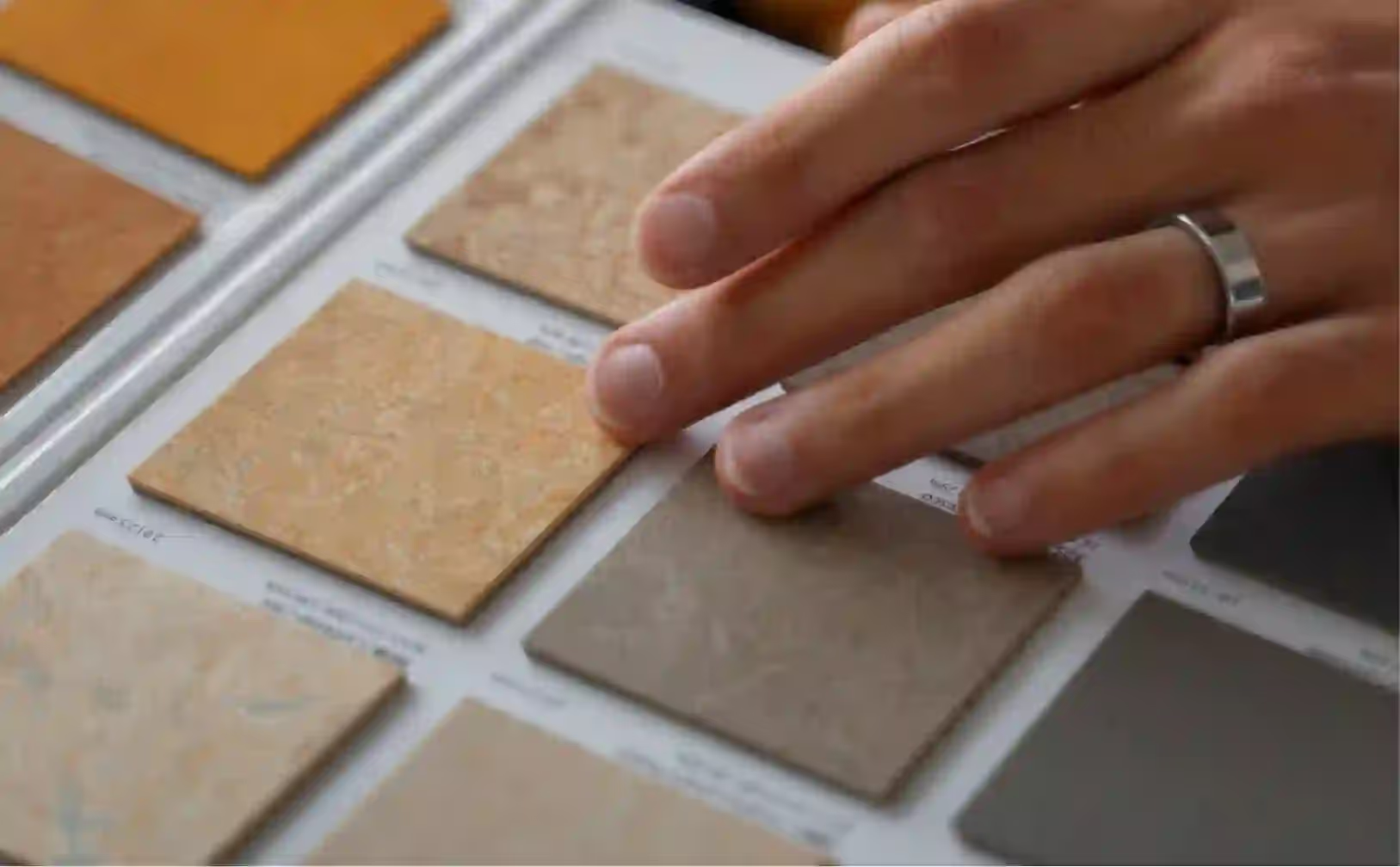
Real-world outcomes illustrate how splurge-versus-save decisions play out across actual projects.
The luxury bathroom under constant repair began with premium intentions. The homeowners selected Carrara marble for countertops, floors, and shower surrounds. They chose a custom frameless glass shower enclosure. They installed a freestanding soaking tub with sophisticated filler. The design was stunning. The execution was competent. The cost was significant—over $45,000 for a primary bathroom renovation.
Three years later, the marble showed wear that the homeowners hadn't anticipated despite research. Etching marks near the sink where water with traces of toothpaste had sat. Staining on the shower floor despite regular sealing. The frameless glass required constant squeegee attention to prevent water spots. The freestanding tub's exposed plumbing had developed mineral buildup that required professional cleaning. The bathroom that was supposed to feel like a spa felt like a maintenance burden.
The homeowners found themselves avoiding using the bathroom in certain ways to prevent further damage, which defeats the purpose of a luxurious space. When they calculated the ongoing sealing costs, the professional cleaning, the special products the materials required, they realized the bathroom was costing hundreds of dollars annually in maintenance—maintenance their previous budget bathroom had never required.
The mid-tier kitchen holding up after eight years took a different approach. These homeowners chose quartz countertops—a middle-tier price point with premium performance characteristics. They selected quality but not luxury cabinetry—all-plywood construction with thermofoil doors, soft-close hinges and full-extension drawers. They installed luxury vinyl plank flooring, accepting its aesthetic limitations relative to hardwood in exchange for moisture resistance and durability.
The total project cost came in around $38,000—substantial, but not the $60,000+ a comparable kitchen with premium everything would have cost. Eight years later, the quartz looks identical to installation day. The cabinets function smoothly, with no hinge issues or drawer problems. The flooring shows no wear despite heavy family use including young children and a dog.
These homeowners report that they don't think about their kitchen—it just works. That absence of thought represents the value their material choices delivered: satisfaction without maintenance burden, durability without ongoing investment, quality that doesn't demand attention.
The National Association of the Remodeling Industry (NARI) represents professionals whose daily work exposes them to the long-term performance of material choices across thousands of projects. Their perspective reveals patterns that homeowners, with exposure to only their own projects, might miss.
Experienced contractors consistently prioritize structural and waterproofing elements over finish elements when advising clients with limited budgets. "I'll tell clients to save on the tile but spend on the waterproofing membrane," explains the typical contractor perspective. "The tile is what they'll see, but the membrane is what determines whether the shower still works in ten years."
Problem areas contractors see fail most frequently include shower systems where inadequate waterproofing leads to water damage; window and door installations where inadequate flashing leads to water intrusion; floor transitions where improper substrate preparation leads to cracking or separation; and exterior systems where inadequate moisture management leads to structural damage.
The contractor consensus: splurge on what you can't see but will regret if it fails; save on what you can see and can replace if preferences change.
Renovation investment interacts with home value in complex ways that affect splurge-versus-save calculations. The Remodeling Magazine Cost vs. Value Report provides data on how specific improvements translate to resale value.
The general pattern: exterior improvements recoup more of their cost than interior improvements; maintenance-type improvements recoup more than luxury improvements; mid-range versions of improvements often recoup comparable percentages to upscale versions despite costing much less.
A mid-range kitchen renovation might cost $75,000 and recoup 50-60% of that cost in increased home value. An upscale kitchen renovation might cost $150,000 and recoup 40-50%—a similar percentage but of a much larger number. The upscale kitchen returns more absolute dollars but represents less efficient investment if ROI is the primary consideration.
This pattern suggests that budget-to-mid-range renovations often deliver better ROI than premium renovations, at least in terms of resale recovery. The $50,000 spent on solid mid-range improvements may add more to home value than the first $50,000 of a $100,000 luxury renovation.
However, ROI isn't the only relevant consideration. Homeowners who plan long occupancy periods derive value from daily enjoyment of their spaces that recoupment calculations don't capture. The premium finish that adds $5,000 to project cost but only $3,000 to resale value might still be worthwhile if it adds daily satisfaction over ten years of living with it.
Priority items in appraisal evaluations include kitchen and bathroom quality, flooring condition, HVAC systems, roof condition, and windows. Appraisers notice updates in these categories and adjust valuations accordingly. Decorative improvements—paint colors, light fixtures, landscaping features—receive less appraisal attention. This suggests concentrating renovation investment in appraisal-visible categories for maximum value impact.
A practical framework simplifies splurge-versus-save decisions by categorizing material choices according to their importance profile.
This framework acknowledges that budget constraints require prioritization. Every dollar directed toward "smart save" categories frees a dollar for "must splurge" categories where the investment delivers its greatest return.
Systematic evaluation helps ensure that individual decisions align with overall project strategy. Before committing to any significant material choice, consider these questions.
Budget Allocation Strategy
Budgets force trade-offs. Allocating those budgets strategically maximizes value across the entire project rather than in any single element.
Material choices made today will exist in your home for years or decades. Future-proofing means selecting materials that remain satisfying as your life changes, trends evolve, and the home ages.
The "trend versus timeless" distinction helps evaluate longevity risk. Trendy materials—those popular right now because they're novel—may feel dated as preferences shift. Timeless materials—those that have remained appealing across decades of style evolution—carry less datedness risk. Subway tile has worked in homes for a century. The bold geometric pattern popular this year may feel regrettable in ten years.
Commercial-grade materials for residential use often deliver superior durability because they're engineered for more demanding conditions than residential products face. Commercial-grade flooring withstands traffic volumes exceeding anything residential use generates. Commercial-grade fixtures are built for continuous use that residential use doesn't approach. These products typically cost more than residential-grade equivalents but deliver proportionally better longevity.
Universal design considerations future-proof against changing physical needs. Choices that work well for all ages and abilities—wider doorways, curbless showers, lever handles, good lighting—remain functional if health or mobility changes. Choices that only work for full mobility may require costly modification if needs change. For homeowners planning long-term occupancy, universal design elements provide insurance against unpredictable future requirements.
Neutral base finishes with personality through changeable elements future-proofs against taste evolution. A bathroom with neutral tile and white fixtures can be transformed through paint color, accessories, and textiles. A bathroom with bold statement tile locks in an aesthetic that may not suit future preferences. Concentrating design boldness in easily changeable elements preserves flexibility while allowing current taste expression.
The renovation reveal—the moment when the project completes and the transformed space first appears—dominates how we imagine renovation success. Design shows build toward it. Social media showcases it. Our planning tends to optimize for how the space will look and feel in that moment.
But the reveal is one moment in what may be ten thousand moments of living with the renovation. The choices that produce the most dramatic reveal often don't produce the most satisfying long-term experience. The statement materials that photograph beautifully may demand maintenance that drains daily satisfaction. The trendy finishes that feel exciting initially may feel dated before they wear out.
The most successful renovations balance reveal impact with long-term livability. They invest where investment delivers compounding returns through durability, reduced maintenance, and sustained satisfaction. They economize where economy doesn't sacrifice the elements that determine whether the renovation still feels like a good decision in year eight.
The framework presented here—understanding lifecycle cost, recognizing psychological biases, categorizing decisions by importance profile, allocating budgets strategically—enables that balance. Following this approach won't produce the most dramatic before-and-after photos. It will produce something more valuable: spaces that work well, age gracefully, and generate satisfaction rather than regret across years of actual living.
The splurge-versus-save decision isn't really about budget constraints, though budgets are real. It's about understanding what you're actually buying with each dollar spent. Some dollars buy decades of reliable performance. Some dollars buy momentary excitement that fades into ongoing headaches. Some dollars are necessary investments in preventing failures. Some dollars are optional expressions of aesthetic preference.
Knowing which dollars are which transforms renovation from a series of stress-inducing choices into strategic investment in your home and your life within it. That knowledge is worth more than any particular material upgrade—and it costs only the willingness to look past the surface to understand what each choice actually delivers.
DECEMBER 01, 2025
DECEMBER 01, 2025
DECEMBER 01, 2025
DECEMBER 01, 2025
DECEMBER 01, 2025