

Why Renovation Fatigue Is Real — and How to Recover From It
DECEMBER 01, 2025
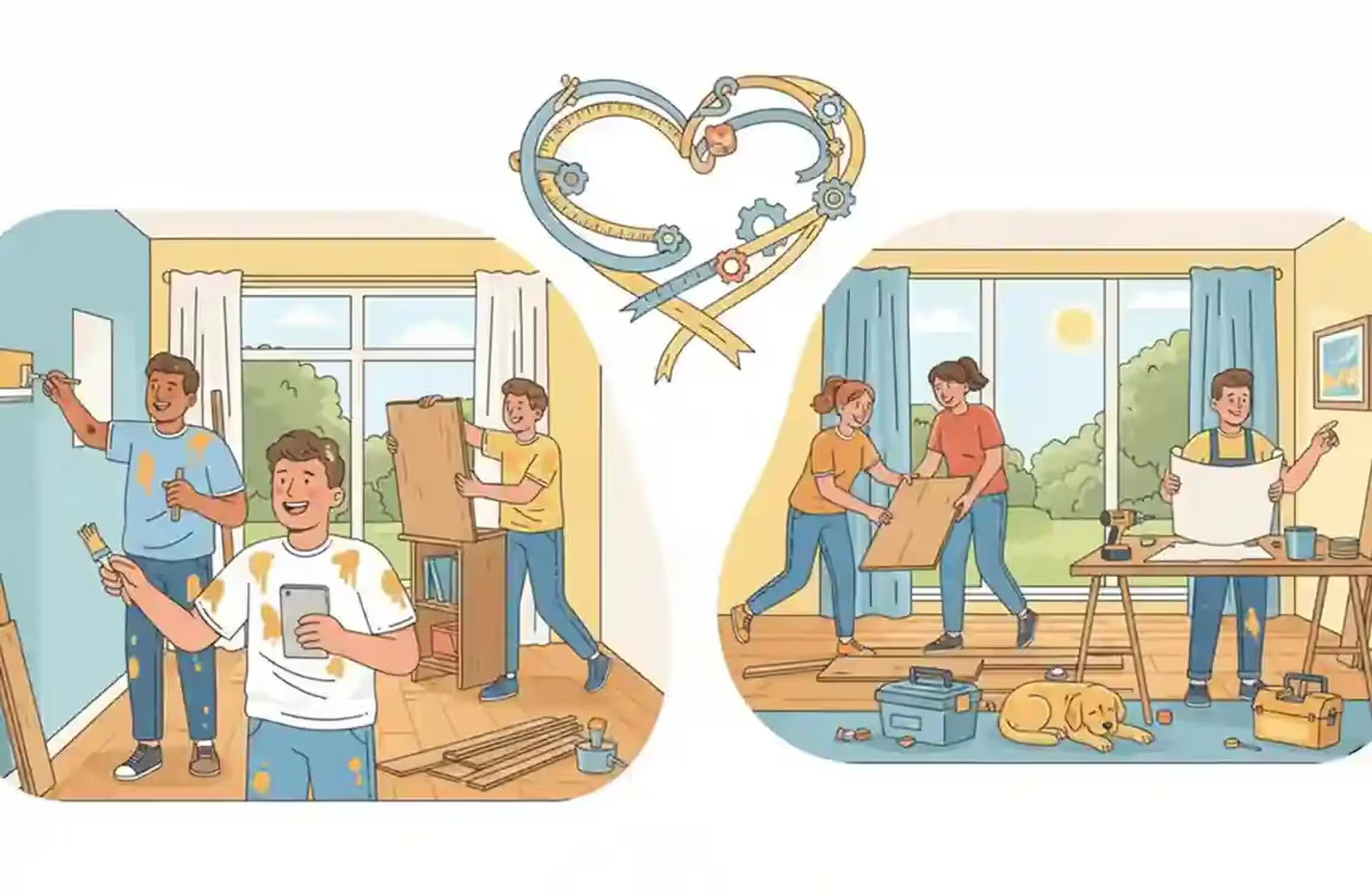
You tore down a wall and discovered your partner's true feelings about money. You chose tile together and unearthed decades-old power struggles. The dust has settled, but the arguments haven't stopped. Welcome to the ultimate marriage stress test—where grout joints become fault lines and every fixture is a referendum on your relationship. This is what happens when "for better or worse" meets "for drywall and debris." Home renovation projects have an extraordinary capacity to expose the fault lines in even the strongest relationships, transforming what should be an exciting transformation into a crucible that tests every aspect of partnership, communication, and mutual respect.
Remodeling is often romanticized as a couple's adventure—a shared dream built with sweat equity and mutual vision. The reality is more like a psychological obstacle course designed by a sadistic contractor. According to a comprehensive Houzz Remodeling and Relationships Survey, over 50% of couples who have undergone home renovations report that the process caused significant marital stress, with a startling 12% admitting they considered separation or divorce during the project. The project becomes a crucible where communication patterns, power dynamics, financial values, and conflict styles are heated to their breaking point. What begins as selecting paint colors and cabinet hardware often ends with couples questioning fundamental aspects of their compatibility and wondering how a simple kitchen remodel could threaten years of partnership.
What makes remodeling uniquely destructive is its combination of high stakes, constant decision fatigue, financial vulnerability, and home invasion—all while you're supposed to maintain normal life. It's like performing surgery on your own house while trying to cook dinner in the operating room. The Psychology Today analysis of renovation conflicts explains that all of the issues that emerge during renovations are actually underlying problems in the relationships that the stress of construction merely brings to the surface. Renovating doesn't break relationships; it reveals cracks that were already there, making the remodeling process both a diagnostic tool and a potential healing opportunity for couples willing to face what the stress uncovers. This guide maps the relational minefield and offers field-tested strategies for couples who want to emerge stronger, not just with a prettier kitchen.
Remodeling creates a perfect storm of relationship stressors that overwhelm even healthy partnerships. The first ingredient is territorial invasion. Your home—historically a safe haven for decompression—becomes a construction zone where strangers traipse through your bedroom and you can't find a clean mug. This triggers primal threat responses; the amygdala doesn't distinguish between a contractor and a predator in your den. The psychological impact of having your sanctuary disrupted cannot be overstated, as research consistently shows that environmental stability plays a crucial role in emotional regulation and relationship satisfaction. When couples lose their physical refuge, they also lose the space where they typically reconnect, decompress, and resolve minor conflicts before they escalate into major battles.
Second is decision fatigue on steroids. Psychologist Roy Baumeister's groundbreaking research, discussed extensively in the Wikipedia overview of decision fatigue, shows that willpower is a finite resource that depletes with each choice we make throughout the day. Remodeling demands hundreds of decisions daily—tile, grout, faucet height, socket placement, paint sheen, hardware finish, lighting placement, and countless other details that seem trivial individually but accumulate into an overwhelming cognitive load. By dinner, your decision-making muscle is exhausted, leaving you snappish over dishwasher loading or which restaurant to choose. Studies have found that decision overload directly correlates with increased conflict in domestic partnerships, as partners who have spent their mental energy on renovation choices have nothing left for the emotional intelligence required to navigate relationship dynamics effectively.
Third is financial nakedness. Few things expose financial values like watching tens of thousands of dollars disappear into a wall. Spenders feel suffocated by constant budget discussions; savers feel terror watching carefully accumulated reserves evaporate. The power imbalance becomes visceral when one partner earns more or contributed more to the budget, and money becomes a scorecard of contribution and worth. According to the American Psychological Association's research on money and relationships, financial worries consistently top the list of sources of stress in Americans' lives, impacting all ages, genders, and racial and ethnic groups. When renovation costs inevitably exceed initial estimates—as they do in approximately 78% of projects—the financial stress intensifies, and partners often find themselves questioning not just the budget but each other's judgment, priorities, and even their suitability as life partners.
Finally, there's temporal collapse. Remodeling occupies every waking thought, crowding out emotional connection and leisure time that couples typically use to maintain their bond. You become project managers, not lovers, discussing grout colors instead of dreams and timelines instead of feelings. Intimacy requires mental space; remodeling devours it completely. The partner who tries to discuss feelings is accused of "not understanding the timeline," while the one focused on logistics is labeled "emotionally unavailable." Both are right, and both suffer from the fundamental truth that human beings have limited cognitive and emotional bandwidth, and renovation projects consume far more than most couples anticipate when they enthusiastically begin planning their dream home improvements.
While every remodel is unique, conflict patterns are remarkably predictable across couples of all backgrounds and relationship histories. The first flashpoint is style and aesthetics. One partner wants modern minimalism; the other craves cozy traditional. These aren't just taste differences—they're identity statements that go to the core of how each person sees themselves and wants their home to reflect their values. The minimalist partner feels their desire for order is being called "cold"; the traditionalist feels their warmth is labeled "cluttered." The fight isn't about cabinet doors; it's about whose self-concept gets validated in the shared space. According to the Houzz survey, one-third of couples reported not liking their significant other's taste, making aesthetic disagreements one of the most common sources of renovation conflict and forcing couples to confront differences they may have successfully avoided for years.
The second flashpoint is budget and spending. This exposes core money scripts that each partner developed in childhood: "spending on beauty is wasteful" versus "skimping is short-sighted." The saver feels unsafe watching money flow out; the spender feels judged for every desire to upgrade or enhance. Each purchase becomes a referendum on your values, and the research on financial therapy for couples emphasizes that fighting about money is never just about dollars and cents—money has emotional roots that go much deeper, serving as a stand-in for love, security, power, and self-worth depending on each partner's history and psychology. Financial conflicts during renovation often reveal that couples have never truly aligned their money values, having simply avoided the topic or compromised superficially without addressing the underlying emotional drivers of their financial behaviors.
Third is timeline and pace. One partner wants it done yesterday; the other values deliberation and careful consideration of each choice. The "hurry up" partner feels stuck in limbo, unable to move forward with life until the renovation concludes; the "slow down" partner feels bulldozed and pressured into decisions they're not ready to make. This often maps onto attachment patterns developed in childhood: the anxiously attached partner needs resolution and closure; the avoidantly attached partner needs control and space to process. The renovation exposes these fundamental differences in how partners approach uncertainty and change, creating conflicts that seem to be about construction timelines but are actually about deeply ingrained approaches to life decisions and stress management.
Fourth is division of labor. Who manages contractors? Who researches fixtures? Who cleans dust? Who coordinates deliveries? The partner who takes on more often becomes resentful ("I'm doing everything while you just show up for the fun parts") while the other feels incompetent and excluded ("Nothing I do is right, so why bother?"). This is classic invisible work imbalance amplified by high stakes. Studies have found that in heterosexual couples, women managed 73% of remodeling logistics, even when both partners worked full-time, creating what researchers call the "project management penalty" that carries over into post-remodel resentment. The pattern often replicates broader household labor imbalances, making renovation a magnifying glass for inequities that may have simmered beneath the surface of daily life.
Finally, there's post-project dissatisfaction. Even if the remodel is objectively perfect, one partner may feel let down. The fantasy of "once we have this beautiful kitchen, we'll be happy" collides with reality: you're still you, just with nicer countertops. Your relationship problems didn't disappear with the old cabinets. This existential disappointment can metastasize into blame: "You rushed me," "You picked the wrong thing," "If you had listened to me, this would be better." The realization that external changes don't solve internal problems can be profoundly destabilizing, particularly for couples who unconsciously hoped the renovation would fix their relationship rather than just their home.

Dr. John Gottman's famous "Four Horsemen"—criticism, contempt, defensiveness, and stonewalling—appear with alarming frequency during remodeling projects, often in couples who had previously managed to avoid these destructive patterns. According to the Gottman Institute's research on relationship communication, these four communication patterns are the strongest predictors of divorce, and the stress of renovation creates perfect conditions for their emergence. Criticism shows up as "You always pick the cheap option" instead of "I'm worried about quality." The attack on character rather than behavior escalates conflict instantly, putting the criticized partner on the defensive and making productive problem-solving nearly impossible. What might have been a simple discussion about budget priorities becomes a character assassination that wounds deeply and takes days to repair.
Contempt is the deadliest of the Four Horsemen and often emerges when partners are exhausted, frustrated, and feel unheard. It manifests as eye-rolling when your partner suggests a solution, sarcastic comments like "Sure, let's just spend even more money," or mockery of their taste and judgment. Contempt signals deep disrespect and is the strongest predictor of divorce because it attacks the partner's sense of self-worth rather than addressing the issue at hand. Research even shows that couples who are contemptuous of each other are more likely to suffer from infectious illness due to weakened immune systems. During remodeling, contempt is often triggered by feeling unheard or disrespected after multiple attempts to communicate preferences that seemed to fall on deaf ears, creating a cumulative effect where partners begin to see each other as adversaries rather than teammates facing a challenge together.
Defensiveness is the reflexive "It's not my fault!" when a tile shipment is delayed or a contractor makes an error. It blocks problem-solving and leaves the initiating partner feeling alone with the burden of whatever went wrong. When one partner brings up a concern and the other immediately deflects responsibility, no progress can be made toward resolution. Stonewalling—shutting down, walking away, refusing to discuss—is the avoidant partner's coping mechanism when overwhelmed by conflict or emotion. The more the anxious partner pursues and demands engagement, the more the avoidant partner withdraws, creating a pursue-withdraw cycle that escalates rather than resolves conflict. During renovation, when stressors are constant and unavoidable, this cycle can repeat multiple times daily, wearing down the relationship's foundation faster than any demolition crew could dismantle a wall.
The antidote to these destructive patterns requires conscious effort and practice, ideally established before the renovation begins but valuable at any point in the process. Gentle start-up ("I'm feeling anxious about the budget. Can we talk?") replaces criticism with a statement of personal feeling and a request for connection. Contempt prevention involves catching yourself before you roll your eyes and instead expressing your frustration directly ("I feel dismissed when my ideas are rejected without discussion"). Taking responsibility ("You're right, I should have confirmed the delivery date") replaces defensiveness with accountability that allows the conversation to move forward. Self-soothing breaks ("I'm overwhelmed. I need 20 minutes, then I'll be back to discuss this") replace stonewalling with a commitment to return and engage once emotional regulation is restored.
Remodeling surfaces hidden power imbalances that may have remained dormant during ordinary daily life. The partner who earns more often feels entitled to final say on expensive decisions; the partner who manages the project feels entitled to authority over details and execution. The result is stalemate or resentment, with neither partner feeling respected or empowered. Research published in family therapy journals found that egalitarian decision-making during renovations predicted higher relationship satisfaction five years later, regardless of budget size or project complexity. The couples who thrived weren't those who agreed on everything but those who developed fair processes for navigating disagreement that left both partners feeling valued and heard.
The key is decision pre-nuptials: before demolition begins, designate categories where each partner has veto power and final authority. For example, Partner A has final say on kitchen design; Partner B controls bathroom decisions. For shared spaces like living rooms and bedrooms, require consensus but set a "good enough" threshold—if you're 80% aligned, move forward rather than pursuing perfect agreement that may never come. Perfect is the enemy of done and of marital harmony. The Focus on the Family guidance on remodeling stress emphasizes that couples who build their renovation approach on a foundation of kindness, willingness to compromise, and prioritization of relationship over project outcomes consistently report better experiences regardless of how the actual construction unfolds.
Another effective approach is the "lead and support" model: one partner leads on design decisions, the other on logistics and contractor management. The supporter's role is to ask clarifying questions and trust the lead's judgment, not to second-guess every decision or undermine their authority. This leverages each partner's strengths while preventing endless debate that exhausts both parties and delays the project. The critical element is that both partners must agree to and respect the division of authority, rather than having it imposed by the partner with more power or stronger opinions. When both partners feel ownership of their domain and trust that their partner will honor their decisions, the renovation becomes a collaborative project rather than a power struggle.
Money is remodeling's third rail—touch it carelessly and the resulting shock can devastate your relationship. Overruns trigger primal fears of security and worth that may trace back to childhood experiences of scarcity or abundance. The partner who pushes for "just one more upgrade" may be seeking status or trying to create the beautiful home they never had growing up; the one who panics over every penny may be clinging to control as a way of managing anxiety about an uncertain future. Both are deploying survival strategies learned long before they met each other, and neither is inherently wrong—they're simply incompatible without conscious communication and mutual understanding of what money represents to each person.
The shame spiral is particularly toxic and can destroy relationship trust faster than any budget overrun. The saver feels shame for "not being able to afford it" or "being cheap"; the spender feels shame for "being irresponsible" or "wanting too much." This shame gets projected onto the partner: "You're making us poor" versus "You're making us live in squalor." The financial therapy research from the University of Georgia has found that the number one reason for arguments in relationships is often money, and that therapists need to work together to solve problems that occur around financial behaviors of couples. The research revealed that when partners were encouraged to share their financial goals and discuss how their money history related to their current situation in a nonjudgmental space, they gained crucial insights that transformed their relationship with both money and each other.
The antidote is radical transparency and equality. Create a shared spreadsheet visible to both partners at all times, eliminating the secrecy that breeds suspicion and resentment. Schedule weekly "money dates" with wine and a strict no-judgment rule—these become opportunities to connect rather than conflict, to understand rather than attack. Each partner gets equal voice in financial decisions, regardless of who earns more or contributed more to the renovation budget. Build a 15-20% "contingency fund" for overruns and announce it as "our safety net," not a failure fund that triggers shame when accessed. When overruns inevitably occur, they draw from a resource specifically designated for that purpose rather than feeling like a catastrophe that threatens your financial security or proves someone's poor judgment.
One partner researches fixtures for six hours; the other doesn't notice. One meets every contractor and coordinates every delivery; the other shows up for the reveal and offers opinions on the finished product. The invisible work imbalance is remodeling's silent killer, creating resentment that poisons daily interactions long after the project concludes. The "manager" partner becomes filled with resentment at carrying the mental load alone; the "spectator" feels incompetent, excluded, and unfairly criticized for not contributing to work they weren't even aware needed doing. This dynamic often replicates broader household patterns, making renovation a concentrated version of imbalances that may have simmered for years without explicit discussion.
The Marriage.com analysis of renovation relationship stress notes that home renovation relationship stress is real and affects virtually every couple who undertakes a significant project together. Both partners will certainly experience strong emotions and stressors during an expensive and time-consuming remodel. But if those stressors and anxieties aren't communicated openly, they build up over time and manifest in arguments and fights that seem disproportionate to their triggers. The partner who spent hours researching tile options may explode when asked "why does it matter?"—not because of the question itself but because of the accumulated frustration of invisible labor that seems unappreciated and undervalued.
The solution is visible work tracking that makes the invisible visible. Use a shared app like Trello, Asana, or even a simple shared document where every task is logged and credited to whoever completed it. The partner who "just shows up" can see the 47 micro-tasks behind their one decision, developing appreciation for the work they hadn't realized was happening. This isn't about keeping score in a competitive sense; it's about making labor visible so appreciation can flow naturally and both partners understand what the renovation actually requires. Weekly check-ins where both partners acknowledge each other's contributions create opportunities for gratitude that strengthen the relationship rather than taking contributions for granted until resentment explodes in conflict.
Remodeling is an intimacy killer that systematically eliminates the conditions couples need to maintain emotional and physical connection. You're sharing a bathroom with a bucket, sleeping on a mattress in the living room, and discussing sewage pipes over breakfast. The mental load leaves no room for romance, and physical intimacy feels impossible when you're both exhausted, dirty, and surrounded by construction chaos. The spaces where couples typically connect—the bedroom for physical intimacy, the kitchen for shared meals, the living room for evening relaxation—are often the very spaces under construction, leaving no refuge for the relationship itself.
Yet maintaining connection is crucial precisely because the stress is so intense. The 10-minute daily debrief—no project talk allowed, just "How are you feeling?"—prevents emotional drift that can become permanent if left unchecked. Schedule "project-free zones" like Sunday mornings where discussing the remodel is forbidden, preserving your identity as a couple rather than co-managers of a construction project. These protected times remind both partners why they're doing this renovation in the first place: to create a better life together, not to sacrifice their relationship on the altar of home improvement. The Conversation article on renovation and relationships emphasizes that renovations widen relationship cracks as couples find themselves navigating financial stresses, extended disruptions, and thousands of decisions—making protected couple time even more essential for survival.
Physical intimacy can be maintained through micro-affections even when sex is off the table: a 6-second kiss before the contractor arrives, holding hands while reviewing budgets, a back rub while discussing tile selections, a sincere compliment about how your partner handled a difficult situation. These small gestures release oxytocin and maintain the physiological bond that sustains relationships through stress. Research on relationship maintenance consistently shows that small, frequent positive interactions matter more than occasional grand gestures, making daily micro-affections during renovation a lifeline that keeps partners connected until the chaos subsides and normal intimacy patterns can resume.
Fights during remodeling are inevitable—the combination of stress, exhaustion, and constant decision-making makes conflict virtually guaranteed. The key is repair speed. Gottman's research shows that couples who repair within 24 hours are unlikely to divorce; those who let resentment fester are in danger of permanent damage. The problem is that remodeling creates new fights before you've repaired the old one, leading to accumulated grievances that compound until the relationship buckles under their weight. Each unresolved conflict becomes kindling for the next, until partners find themselves fighting about ten things at once while unable to remember what started the original disagreement.
Establish repair rituals that both partners commit to honoring regardless of how angry they feel in the moment. The "10-Minute Rule" is golden: after a blow-up, either partner can call a 10-minute pause without explanation or argument. Walk around the block, breathe deeply in the car, do whatever helps you regulate your nervous system—then return to the conversation. Research from the Berkeley Greater Good Science Center shows that physiological arousal drops significantly after 7–10 minutes away from a triggering situation, allowing the rational brain to re-engage and productive conversation to resume. The partner who called the pause must honor their commitment to return—this isn't an escape hatch but a regulation strategy that makes better communication possible.
Another powerful ritual is the 6-second kiss every morning and evening, regardless of what conflicts occurred the previous day. This research-backed practice releases oxytocin and dopamine, creating a physiological bond that can survive daily stress and remind both partners of the love underlying their temporary frustration. It's hard to stay genuinely mad at someone you kiss meaningfully twice a day. Additionally, establish a weekly "clearing" conversation where each partner can voice one lingering concern from the past week without interruption or defense—just listening and acknowledgment. This prevents the accumulation of minor grievances that eventually explode into major conflicts, giving each partner regular opportunities to feel heard before frustration reaches critical mass.
Sometimes the dynamics are too entrenched or the stress too overwhelming for couples to navigate alone. Calling a therapist before the project starts is preventive maintenance, not a sign of failure—just as you'd hire an architect to prevent structural problems, a therapist can help prevent relational ones. Look for someone specializing in life transitions, financial therapy, or couples communication. Many therapists now offer "remodeling packages"—three sessions before, during, and after—recognizing that home renovation has become a common relationship stressor requiring specific intervention strategies. The Tribeca Therapy approach to financial couples therapy emphasizes that their expertise isn't in interest rates or design strategies, but in decision-making, consensus-forming, and crisis-stabilizing—exactly the skills couples need during renovation stress.
A mediator can be invaluable for intractable style disputes that have become proxies for deeper conflicts. They don't choose for you; they help you articulate what each choice means emotionally. "Hexagonal tile means I'm creative and modern" versus "subway tile means I'm practical and safe." Once the underlying meaning is clear, compromise becomes possible because you're addressing the real need rather than fighting about the surface manifestation. A skilled mediator can also help couples recognize when they're arguing about the past or projecting fears about the future rather than actually discussing the tile choice at hand, redirecting the conversation to productive territory.
Sometimes the contractor becomes an inadvertent therapist, and a good one can provide valuable perspective. An experienced contractor has witnessed hundreds of couples navigate renovation stress and can say, "I've seen this disagreement before. Here's how other couples solved it." Their neutrality can break logjams that feel insurmountable to the couple stuck in the middle of them. Conversely, a contractor who plays favorites, agrees with one partner to win approval, or takes sides in disputes can destroy trust and escalate conflict. Address this directly if it occurs: "We need you to be Switzerland—present options neutrally and let us make the decision together." The right professionals can transform a relationship-threatening renovation into a growth opportunity; the wrong ones can accelerate the damage.

Six months after completion, assess your relationship, not just your space. The beautiful new kitchen matters less than what the process revealed and developed in your partnership. Did you develop better communication patterns that will serve you in future challenges? Can you now name each other's stress triggers and respond supportively rather than reactively? Did you learn to repair faster after conflicts? Did you discover new appreciation for each other's strengths? If yes, the remodel was a crucible that strengthened your marriage, forging bonds that will hold through future challenges. The renovation stress was an investment in relationship development, not just home improvement.
If you find yourselves disconnected, don't despair—the post-project period is actually ideal for rebuilding because the external stressor has been removed. Schedule a "relationship renovation" weekend away from the home you just finished, creating space for reflection and reconnection. Discuss what you learned about yourselves and each other: "I now know I need to feel heard before we make decisions," "I learned I panic about money when I'm scared about bigger things," "I discovered that I withdraw when I'm overwhelmed, and I want to work on staying present." These insights are gold, offering a roadmap for relationship improvement that wouldn't have emerged without the stress that revealed the underlying patterns.
Some couples discover fundamental incompatibilities through the renovation process. One wants stability and predictability; the other craves constant change and novelty. One needs to process decisions slowly; the other needs to move fast and adapt. This is valuable data, painful as it is to acknowledge. Better to know now, while you can make informed decisions about your future, than after children or bigger financial commitments that make separation more complicated. Remodeling reveals truth; it's up to you what you do with that revelation. The legal perspective on renovation and divorce notes that while renovations are stressful, they're rarely the sole reason a couple considers ending their relationship—in most cases, there are other issues already causing strife, and the stress of the remodel simply brings them to the surface where they can no longer be ignored.
If you developed good habits during remodeling, institutionalize them—don't let them fade when the external pressure that created them disappears. Keep the weekly money date even when you're not making major financial decisions; the practice of transparent financial communication benefits every aspect of your shared life. Keep the visible task board for household projects, demonstrating ongoing appreciation for each other's contributions rather than returning to invisible labor patterns. Keep the 10-minute daily debrief, preserving the emotional connection that sustained you through construction chaos. These aren't remodeling crutches; they're relationship infrastructure that will serve you through every future challenge, from job changes to health crises to raising children.
Create a relationship highlight reel from the renovation experience: document moments when you navigated well together. "Remember when we compromised on the backsplash and both ended up loving it? That felt good." "Remember when you took over contractor communication during my work crisis? I felt so supported." "Remember when we both laughed about the tile disaster instead of blaming each other? That's who we want to be." Reviewing this quarterly reinforces your identity as a team that solves problems, creating a narrative of partnership success that carries you through future challenges. The renovation becomes a reference point: "We survived that kitchen remodel; we can handle this too."
Finally, celebrate the sacrifice. Acknowledge what each person gave up: "You gave up your vision of a modern kitchen for my farmhouse sink. I see that, and I'm grateful." "You managed the contractors for three months while I was traveling for work. That wasn't fair, and I appreciate it." "You stayed calm when I was panicking about the budget. Your steadiness helped me get through it." This recognition heals invisible wounds and prevents long-term score-keeping that poisons relationships. The partner who felt unappreciated during the project needs to hear explicit gratitude; the partner who compromised their vision needs to know their sacrifice was noticed and valued. These acknowledgments transform potential resentments into relationship-strengthening moments of connection and appreciation.
Remodeling doesn't break relationships; it reveals cracks that were already there, often hidden beneath the surface of daily routines and comfortable patterns. The stress is a diagnostic tool, not a destructive force—though it can become destructive if couples refuse to acknowledge what it reveals or use the pressure as an excuse to attack rather than understand each other. Couples who emerge stronger do so because they faced the truth: about money, power, communication, and vulnerability. They used the renovation as an opportunity for growth rather than a battleground for old grievances.
The most important foundation you pour isn't concrete—it's compassion. Compassion for yourself, struggling through a genuinely difficult experience that tests your limits. Compassion for your partner, who is equally stressed and doing their best with imperfect skills and limited resources. Compassion for the fact that you're both amateurs at this, learning as you go, making mistakes that are inevitable when humans attempt complex projects under pressure. Keep that foundation strong, and the house will stand regardless of what challenges emerge. Let it crack through blame, contempt, and accumulated resentment, and no amount of marble or custom cabinetry can save either the home or the relationship.
Every renovation is an opportunity—to create a more beautiful home, certainly, but also to build a more resilient relationship that can weather future storms. The couples who thrive don't have easier renovations; they have better tools for navigating difficulty together. They communicate rather than assume, repair rather than stonewall, appreciate rather than criticize, and remember that the person across the conflict is the same person they chose to build a life with. The renovation will end; the relationship, if tended well, will not. Choose each other over the project, every time, and both the home and the marriage will emerge stronger than before.
DECEMBER 01, 2025
DECEMBER 01, 2025
DECEMBER 01, 2025
NOVEMBER 28, 2025