

Why Renovation Fatigue Is Real — and How to Recover From It
DECEMBER 01, 2025

The glossy magazines show "before & after" shots, the bank e-mails list "project milestones," and your contractor promises "minimal disruption." None of them show you crying behind a half-painted door because the kitchen is gone, the Wi-Fi is patchy, and every dollar you saved is now dust inside a demolished wall. Welcome to the emotional side of renovation—the part the brochures leave out. This is the psychological territory that home improvement shows conveniently edit away, leaving millions of homeowners blindsided by the emotional toll that accompanies even the most straightforward remodeling projects.
Home-improvement television runs on a 48-minute dopamine cycle: sledgehammer, montage, reveal, tears of joy. Real life runs on 48-day cycles of dust, decisions and debt. Contractors protect your floors with cardboard; nobody protects your nervous system. According to research from Houzz, 12 percent of couples admitted to considering separation or divorce mid-remodel, while 46 percent found the overall experience frustrating rather than fulfilling. This guide is that missing layer of bubble-wrap for your psyche. It will not tell you which grout to pick, but it will tell you how to stay sane while the grout dries. Expect evidence-based tactics, first-person confessions, and a few laughs—because if you cannot laugh when your bathroom is a bucket in the garden, you will cry, and the neighbours already have enough content.
Humans crave territorial control. When half the house is sealed in plastic sheeting, the amygdala treats it like a predator in the shrubs. Cortisol rises, sleep fragments, and the smallest decision—matte or satin finish—feels existential. According to the American Psychological Association's Stress in America surveys, financial concerns consistently rank as the top stressor for Americans, and major home projects combine financial pressure with habitat disruption in ways that compound psychological strain exponentially. The survey data reveals that nearly half of Americans experience significant daily stress, and adding renovation chaos to this baseline creates a perfect storm for mental health challenges.
The evolutionary mismatch compounds the problem significantly. Our ancestors lived in relatively stable caves and huts; sudden structural change signaled danger—fire, flood, invasion. Modern brains still interpret demolished walls as existential threat, triggering fight-or-flight responses even when we consciously know the destruction represents progress rather than peril. This disconnect between rational knowledge and primal alarm creates a unique cognitive dissonance that wears down resilience over time. The prefrontal cortex, responsible for logical thinking, must constantly override the amygdala's alarm signals, creating a state of chronic internal conflict that exhausts mental resources.
Moreover, the constant micro-decisions activate the prefrontal cortex relentlessly. Research on decision fatigue by psychologist Roy Baumeister demonstrates that willpower depletes like a muscle—each choice we make throughout the day reduces our capacity for subsequent decisions. Unlike computer processors, human executive function fatigues measurably. Each choice—socket height, door swing, tile alignment—depletes glucose reserves in the brain. By 4 pm, even choosing dinner feels overwhelming because your neural budget is spent. This "decision bankruptcy" explains why couples snap over takeaway choices after a day of design meetings, and why evening arguments during renovation often have nothing to do with the stated topic.
The physiological impact extends beyond momentary stress into measurable health consequences. Research published in Frontiers in Endocrinology confirms that prolonged stress exposure can lead to digestive problems, hypertension, cardiovascular disease, and immunosuppression. When stress becomes chronic—as it inevitably does during multi-month renovations—the body's inflammatory response remains elevated, creating conditions that increase vulnerability to both physical illness and mental health disorders. Understanding this biological reality helps explain why renovation survivors often report feeling physically unwell even when no obvious illness is present.
Before the first quote arrives, schedule a "feelings audit." Sit with every household member and answer three questions on paper: (1) What does "home" give us right now? (2) Which daily rituals must survive the mess? (3) How will we measure "enough is enough" mid-project? Post the answers on the fridge; they become your psychological contract when dust literally hits the fan. This exercise isn't mere sentimentality—it creates an objective reference point that partners can return to when stress clouds judgment and emotions run high.
Take it deeper by creating a personal values hierarchy for each person in the household. Rank the following: Privacy, Predictability, Visual Calm, Financial Control, and Time Autonomy. When conflicts arise—for example, when one partner wants daily progress photos but the other needs visual calm—refer back to these ranked values to negotiate trade-offs rationally rather than reactively. This prevents arguments from becoming personal attacks and transforms potential conflicts into problem-solving opportunities. According to HuffPost's coverage of renovation relationship dynamics, couples who establish expectations before tensions run high are significantly more likely to prevent major blow-ups during the project.
Before demolition begins, rate each household member on a scale of 1-5 for the following vulnerability factors: sleep quality under stress, need for visual order, financial anxiety threshold, introversion and need for quiet, and history of depression or panic. Any score of 3 or below in any category signals a need for a specific coping plan before demo day. This isn't about labeling anyone as "weak"—it's about identifying where extra support structures need to be built before the stress begins. The person who scores low on sleep quality under stress might need a designated quiet sleeping space away from construction zones. The person with high need for visual order might benefit from having one room designated as completely off-limits to renovation chaos.
Silica dust is an irritant, but unpredictability is the real toxin for mental health. The brain constantly scans for patterns, seeking to predict what comes next as a fundamental survival mechanism; construction provides none of this predictability. Counter this by time-blocking certainty into your schedule. Example: every morning from 7-7:30 am, coffee on the patio—no matter how many trades arrive, no matter what crisis erupted yesterday. This micro-routine tells your limbic system, "Some things are still ours." The ritual doesn't need to be elaborate; it needs to be inviolable.
Noise above 85 decibels spikes heart rate and triggers stress hormone release regardless of whether the noise source is threatening. Construction commonly exceeds this threshold. Invest in active noise-cancelling headphones (not earbuds, which provide inadequate isolation) and preload brown-noise playlists. Brown noise masks hammering better than white noise and feels less harsh to most listeners—think distant waterfall rather than radio static. For sensory-sensitive individuals, create a sensory deprivation kit: blackout curtains for the clean zone, weighted blanket, dedicated noise machine, and a scent anchor such as lavender or cedar oil. Use this kit for 20-minute "sensory resets" when overwhelm peaks. This is not indulgence; it's nervous-system regulation that prevents cumulative damage.
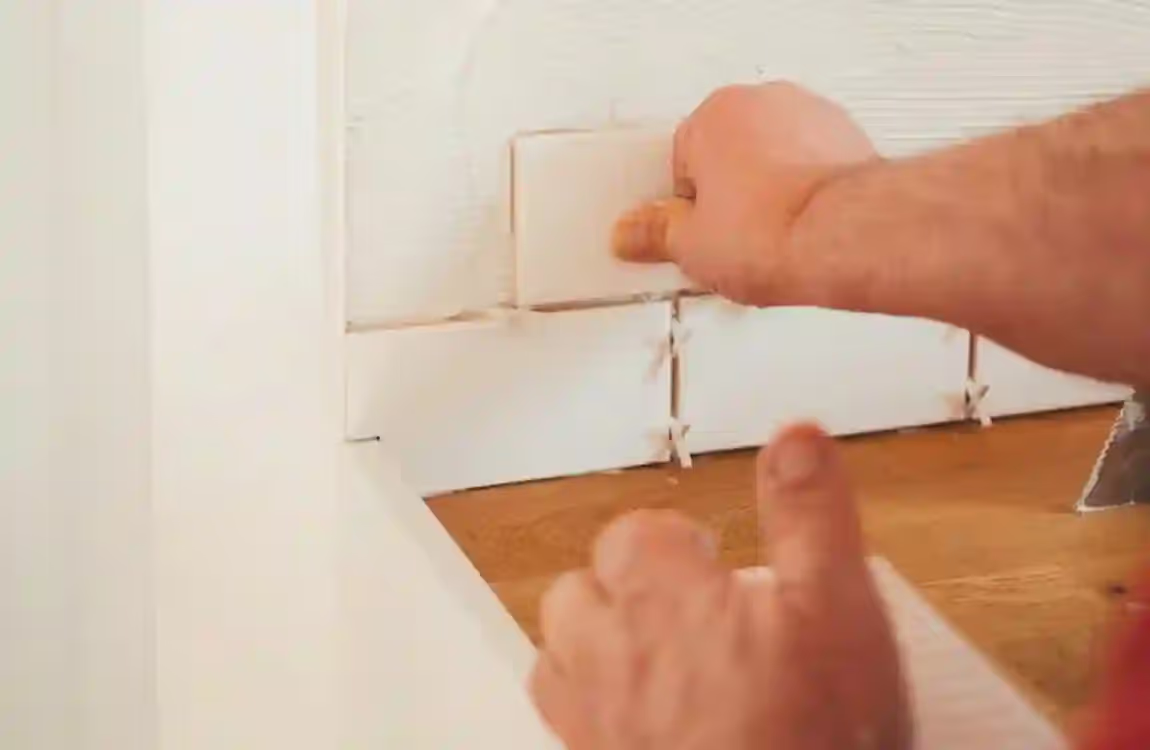
Psychologist Roy Baumeister's research demonstrated that willpower depletes like a muscle with use. Every grout joint, cabinet pull, and paint shade chips away at that mental muscle. His foundational research on ego depletion shows that making decisions can elicit a depleted state of internal resources, affecting emotion regulation and subsequent decision quality. Adopt the 5-Choice Rule: allow yourself only five "open" decisions at any moment. When decision number six appears, park it in a "Later" list. This hard cap prevents the nightly spiral of wondering whether the island should be 2 cm deeper or whether the outlet placement is truly optimal.
The paradox of choice explains why more options create less satisfaction rather than more. A famous study of jam purchases found that shoppers faced with 24 varieties were one-tenth as likely to buy versus those offered just six options. Your brain experiences tile samples exactly the same way—too many choices leads to paralysis, regret, or impulsive decisions followed by buyer's remorse. Limit yourself to three options per category; research consistently shows that the fourth option adds decision time without adding decision quality. When suppliers offer endless catalogs, impose your own constraints before browsing rather than after.
Research on relationship dynamics during major life stressors reveals that couples often report lower relationship satisfaction during renovations than during new-baby or job-loss phases. The culprit is frequently unequal labour perception—one partner feels they're carrying more of the burden, whether that's managing contractors, making decisions, or handling the financial tracking. Create a visible "Who Does What" board where daily micro-tasks go beside names: meet electrician, order pizza, photograph receipts. Visibility shrinks resentment because it eliminates the arguments about who's doing what and replaces assumptions with documented reality.
Institute the 10-Minute Rule: when tension hits 7 out of 10 on anyone's internal scale, either partner can call a 10-minute pause. Walk the block, breathe in the car, sit quietly in another room—then return. Research shows physiological arousal drops significantly after 7-10 minutes away from the triggering situation, allowing the prefrontal cortex to regain control from the amygdala. This isn't avoidance; it's strategic regulation that makes productive conversation possible. According to relationship research covered by Psychology Today's analysis of renovation conflicts, four of the most common conflicts that emerge during renovations are conflicts about control, money, taste, and different ways of managing anxiety. Understanding these patterns helps couples recognize when they're fighting about the actual issue versus when renovation stress has hijacked the conversation.
Add a weekly "state of the union" meeting—not about tasks, but about feelings. Use sentence stems: "This week I felt..." and "What I needed and didn't get was..." This prevents emotional backlog from accumulating, which is what ultimately explodes over seemingly trivial issues like tile adhesive choices or grout color. The meeting should last no more than 20 minutes and should explicitly not include any problem-solving. Its only purpose is emotional expression and acknowledgment. Save the problem-solving for a separate conversation after feelings have been heard.
Sexual intimacy often suffers during renovation, and couples should expect and plan for this rather than interpreting it as relationship decline. Exhaustion, dust in every crevice of your home, and constant presence of strangers create conditions antithetical to romance. Discuss this openly rather than allowing resentment to build. Some couples find that booking occasional overnight escapes—even just to a local hotel—provides necessary privacy and respite that maintains connection through the chaos.
Children under eight interpret visible chaos as personal instability. Their developing brains lack the cognitive capacity to separate "our house is being improved" from "my world is falling apart." Maintain "anchor objects"—their bedding, favourite cup, bedtime story location—unchanged throughout the renovation. Label boxes containing stuffed animals so they travel safely and reappear intact when needed. Teens need control rather than protection: give them one design element to own completely, whether that's gaming chair colour, neon strip placement behind their desk, or bathroom tile selection.
For toddlers, create a "construction story" with toy trucks and builders so the noise becomes part of imaginative play rather than undefined threat. Primary-age children benefit from "treasure hunts" in the clean zone—hide small prizes daily to create positive associations with the only intact room in the house. The goal is to give children agency and positive experiences that counterbalance the disruption they cannot control or fully understand.
Pets mirror their owners' cortisol levels, making them particularly vulnerable during renovation stress. Create a dedicated safe room with a white-noise machine, Adaptil diffusers for dogs or Feliway for cats, and daily "happy moments" at exactly the same time construction pauses for lunch. Consistency matters more than quantity—a brief reliable routine is more regulating than sporadic longer interactions. For dogs, schedule a mid-day walker to break up noise exposure. For cats, install high perches where they can observe activity from safety while maintaining escape routes to quieter zones.
Budget overruns activate the brain's loss-aversion circuitry—research consistently shows we feel losses more intensely than equivalent gains. According to Clever Real Estate's renovation research, 78 percent of homeowners went over budget on their last renovation project, with 44 percent exceeding their budget by at least $5,000 and 35 percent exceeding it by $10,000 or more. Nearly two-thirds of homeowners have gone into debt to fund renovations. When overruns inevitably occur, the resulting shame can poison relationships if left unaddressed.
Counter shame with radical transparency: share the spreadsheet with everyone affected by the budget. Weekly "money minutes" (timer set, 60 seconds each to speak) stop late-night whisper fights and accusations from festering. Use a traffic-light system: green means under budget, amber means 0-10 percent over, red means the situation needs an emergency plan. Naming the colour moves discussion from blame to problem-solving. Shame thrives in secrecy, so create a "money circle"—two trusted friends who have renovated recently. Text them when you hit amber alert; their "we've been there" normalisation dissipates shame faster than any spreadsheet could. Social connection is the antidote to financial humiliation.
Physical grounding interrupts catastrophic forecasting by forcing the brain into present-moment awareness rather than future-oriented anxiety. Keep this script on your phone for moments when panic threatens to overwhelm rational thought.
Even if you hated the old kitchen, you may mourn its disappearance. This is ambient grief—loss of the familiar, the known shortcuts, the muscle memory of where the light switch was. Acknowledge it rather than dismissing it as irrational. Take a photo of the worst corner and write one thing you will miss about even that imperfect space. This ritual honours the past without romanticising it, allowing your brain to close the chapter properly rather than leaving unfinished emotional business that resurfaces as inexplicable sadness or irritability.
The same principle applies to routines. If Sunday pancakes happened in that kitchen, plan a temporary "pancake picnic" in the living room. Preserving the ritual while releasing the location tells your psyche that core identity survives the drywall massacre. The meaning persists even when the setting changes. This is particularly important for families with children, who may struggle to articulate their sense of loss but will feel it nonetheless.
Understanding the arc of renovation stress helps normalise the madness and predict when extra support will be needed. Phase 1 (Days 1-30): Honeymoon & Horror—initial excitement crashes into the first major obstacle, whether that's hidden wiring, delayed delivery, or unexpected costs. Adrenaline masks exhaustion during this phase, creating a false sense of capability that will not be sustained. Phase 2 (Days 31-90): The Slog—routine chaos becomes the new normal, decision fatigue peaks, and relationships fray. This is the phase where most people abandon self-care precisely when they need it most. Phase 3 (Days 91+): The Home Stretch—fatigue deepens but the end becomes visible; the primary risk is cutting corners out of exhaustion, making "good enough" decisions that you will regret for years.
Each phase needs different support strategies. Phase 1 requires novelty and flexibility—the ability to roll with surprises without catastrophizing. Phase 2 requires structure and recovery—rigid boundaries around self-care and scheduled breaks. Phase 3 requires vision and discipline—reminders of why you started and commitment to quality despite fatigue. Knowing which phase you're in helps calibrate expectations and interventions appropriately. Mark the phases on your calendar and plan support accordingly.
Every renovation contains "gotcha" moments: asbestos discovered behind walls, rot where none was expected, mismatched floorboards requiring complete replacement. Each discovery triggers a mini stress response—heart rate elevation, cortisol release, racing thoughts about implications and costs. Over weeks, these micro-traumas accumulate, creating a baseline of hyper-vigilance. You start bracing for the next bad news before breakfast, which is exhausting even when the bad news doesn't arrive.
Counter this accumulation by instituting a "No News After 4 pm" rule. Contractors can text discoveries, but you don't read those texts until morning. This boundary prevents cortisol from spiking during the hours when you're meant to be winding down for rest. Pair this with a "discovery debrief" ritual: every Friday, review all surprises from the week with a cup of tea and a "what's the actual worst-case?" reframing exercise. Naming the fear shrinks it. Most worst-case scenarios are survivable inconveniences rather than catastrophes, but the brain needs help seeing this when operating in threat-detection mode.
Renovation creates a shame-barrier that contributes to social isolation: you stop inviting friends over because the house is a disaster, and the isolation deepens the stress by removing social support precisely when it's most needed. Schedule one "construction coffee" per fortnight—invite a friend over, give them a metaphorical hard hat, and tour the chaos together. Normalising the mess breaks the shame cycle and maintains your support network. True friends won't judge your dust; they'll bring wine and commiserate.
Online communities provide additional support. The renovation and DIY forums on Reddit include daily "vent threads" where users post photos of the latest disaster and receive instant empathy from others in similar situations. The validation that "it's not just you" is profoundly regulating for the nervous system. Knowing others have survived similar chaos—and emerged with functioning homes—provides hope that the current suffering is temporary rather than permanent.
Having strangers in your personal space is inherently dysregulating. Home is meant to be a refuge from the world; renovation temporarily transforms it into a workplace for people you barely know. According to the Better Business Bureau's contractor guidance, establishing clear expectations and boundaries from the start is essential for a successful contractor relationship. Establish rituals of entry and exit: a brief "good morning" and "thanks for today" creates predictability. Provide a dedicated toilet and coffee station—this isn't just hospitality; it's boundary-setting that keeps workers out of your personal spaces.
Emotional labour is a real cost that homeowners rarely anticipate: you're managing contractors' moods, remembering their preferences, smoothing conflicts between different trades, and maintaining pleasant professionalism when you'd rather scream into a pillow. Add 10 percent to your mental budget for this invisible work. If a contractor is persistently dismissive, communicates poorly, or creates negative energy in your space, consider firing early. The cost of replacing them is typically less than the cortisol they cost you daily, and toxic contractor relationships can damage both the project and your wellbeing.
Sarah, a 34-year-old UX designer, recounts her kitchen extension experience: "We budgeted eighteen thousand pounds for a kitchen extension. By month three we had spent twenty-four thousand and still had no oven. I was pinning 60-hour weeks at my job to cover the shortfall while my husband managed three trades a day. We communicated exclusively through Post-it notes on the microwave. One Tuesday I found myself sobbing because I couldn't decide on an island colour. Not the island itself—just a colour. That night we instituted the 5-Choice Rule, booked an Airbnb for the weekend, and agreed the next decision we'd make together was 'what takeaway tonight?' Sanity returned faster than the plaster dried."
Sarah's husband adds: "The 10-Minute Rule saved us weekly. I'd be ready to explode over a mis-measured worktop, step outside, see a neighbour's cat, and realise I was angry about exhaustion, not timber. We also started a victory log, recording every small win alongside the challenges. Week six entry: 'Sarah didn't murder me when I ordered the wrong handles.' By week twelve we were genuinely laughing again. That log became evidence that we could survive anything together."
The right technology tools can significantly reduce mental load during renovation. A Notion "Reno HQ" template can embed budget tracker, photo diary, decision log, and shared calendar in one mobile-accessible page, eliminating the chaos of scattered information. Google Calendar "quiet blocks"—30-minute appointments marked morning and evening where no trades are scheduled—can be shared with contractors; most respect these boundaries 80 percent of the time. Receipt-tracking apps with shared wallet features let partners photograph every receipt and receive push notifications, eliminating the recurring arguments about whether specific payments were made.
For visual progress tracking, project management tools with photo attachment capabilities allow you to create lists for each phase (Demo, Electrical, Plaster, Paint) with daily photos. Scrolling back through the progression shows tangible progress when your brain insists "nothing is happening." Smart-plug diffusers scheduled to release lavender at 9 pm and citrus at 7 am create olfactory anchors that survive visual chaos, providing sensory consistency when everything else is disrupted.
Perfectionism is the renovator's Achilles heel. Research on maximisers versus satisficers consistently shows that perfectionists experience lower post-purchase happiness than those who accept "good enough" outcomes. The perfectionist who agonises over finding the absolute best countertop often ends up less satisfied than the person who picked the first reasonably good option and moved on. Repeat the mantra "Done is better than perfect" when you catch yourself comparing Instagram kitchens at 1 am. Set a "good-enough" threshold for each major decision (e.g., countertop within a certain budget and 90 percent colour match) and declare decisions final once they meet the threshold. Your nervous system will thank you long before your guests notice the minor veining deviation from your ideal.
Practice intentional imperfection: choose one element to deliberately "leave rough"—a reclaimed beam with visible knots, a hand-painted tile with visible brushstroke, an exposed brick wall that's obviously original. This paradoxically reduces anxiety by giving your brain explicit permission to accept flaws everywhere else. The Japanese concept of wabi-sabi, finding beauty in imperfection and impermanence, offers a philosophical framework for embracing the inevitable imperfections that every renovation contains. No project achieves perfection; the goal is creating a space that serves your life well enough to fade into the background of daily living rather than demanding constant attention and criticism.
Document your "good enough" decisions and their outcomes. Months later, you will discover that the decisions you agonized over matter far less than you imagined, while aspects you barely considered prove more important. This retrospective awareness builds decision-making confidence for future projects and life challenges. The tile color that kept you awake for three nights will blend into the background of daily life; the outlet placement you decided in thirty seconds will either serve you well or annoy you for years. Understanding this asymmetry helps calibrate where to invest mental energy.

Rumination is common during renovation: replaying conversations with contractors, obsessing over paint undertones at 3 am, mentally recalculating budget scenarios until dawn. This is intrusive thinking, a hallmark of anxiety that serves no productive purpose but feels impossible to stop. Set a "worry appointment" daily: 15 minutes with a notepad to write every worry without censoring or solving. When renovation thoughts intrude outside that appointed slot, tell yourself "I'll think about that at 6 pm." Research suggests this containment strategy can reduce rumination by 40 percent within two weeks.
If obsessive checking—photos of progress, budget spreadsheet, timeline documents—consumes hours of your day, install app blockers that lock you out after 15 minutes of access. Treat this as a digital cast for an injured limb—temporary restriction that allows healing. The information will still be there when you check tomorrow; checking again tonight changes nothing except your ability to rest. According to stress management research, mindfulness and relaxation interventions are among the most effective strategies for managing cortisol levels during prolonged stress periods like renovations.
Renovation stress is normal and expected. What isn't normal—and requires professional intervention—includes persistent insomnia lasting more than two weeks despite good sleep hygiene, significant changes in appetite or weight that persist beyond the initial adjustment period, increasing reliance on alcohol or substances to cope with daily stress, persistent hopelessness or thoughts of self-harm, and complete withdrawal from social connection and activities that previously brought joy. These signs indicate that stress has crossed from temporary discomfort into clinical territory requiring support beyond self-help strategies and well-meaning advice from friends who have "been through renovations too."
Don't wait until you're in crisis to seek support. A few sessions with a therapist before or during early renovation phases can provide coping tools and perspective that prevent escalation into more serious mental health challenges. Many therapists offer short-term, solution-focused work specifically designed for situational stress—you don't need to commit to years of therapy to benefit from professional guidance during a difficult period. Consider it preventive maintenance for your mental health—the same logic that makes you fix a small roof leak before it becomes structural damage applies to psychological wellbeing. The American Psychological Association provides resources for finding mental health support and understanding when professional intervention is warranted.
When the renovation ends, many people expect immediate relief and joy. Instead, they often experience a confusing emotional flatness or even depression. This is post-project letdown—a common phenomenon where the absence of crisis leaves a void that feels strangely uncomfortable. For months, your nervous system operated in high-alert mode; suddenly returning to baseline can feel like loss rather than relief. Give yourself permission to feel strange during the transition period rather than expecting instant happiness.
Plan deliberate recovery activities for the two weeks following project completion. Schedule activities that bring genuine pleasure rather than immediately launching into the next project or catching up on everything you postponed. Your body needs time to recalibrate cortisol levels and restore depleted resources. Sleep may actually worsen temporarily as your system adjusts to the absence of constant threat signals. Avoid making major decisions during this transition period; your judgment remains compromised by accumulated fatigue even when the external stressor has resolved.
Conduct a formal post-mortem with your partner once you've both had time to recover emotionally—typically two to four weeks after completion. Review what worked, what didn't, and what you would do differently. This conversation should happen without blame, focusing on systems and strategies rather than personal failures. Document these lessons for future reference; you will forget the hard-won wisdom faster than you expect, and the next home project will benefit from this reflection.
Renovation is the rare life event that combines financial risk, habitat invasion, and aesthetic judgement all at once, demanding simultaneous competence in domains most people don't regularly exercise. The psychological challenges are real, measurable, and predictable—which means they're also manageable with proper preparation and ongoing attention. Treat your mind like another load-bearing wall: reinforce early with coping strategies, inspect often for signs of strain, and call in specialists before cracks spread into structural damage. Do that, and you will not just finish with a prettier house—you will finish whole, with relationships intact and mental health preserved.
Keep the dust masks, but also keep the breathing exercises. Choose both the perfect shade of white and the perfect shade of calm. Build in recovery time just as you build in contingency budget. When the skips are hauled away and the scaffolding comes down, the strongest structure standing should be you—not despite the renovation, but because you approached it with the same care for your inner architecture that you brought to your outer walls.
DECEMBER 01, 2025
DECEMBER 01, 2025
DECEMBER 01, 2025
NOVEMBER 28, 2025