

Why Renovation Fatigue Is Real — and How to Recover From It
DECEMBER 01, 2025

The renovation finished three weeks ago. The kitchen is beautiful. Everyone says so. The contractor delivered exactly what was planned—the open layout, the waterfall island, the wall of windows flooding the space with light. It photographs like a magazine spread. Friends express envy. The quality is undeniable.
And yet something feels wrong.
You find yourself standing in this gorgeous space feeling oddly disconnected, like a guest in your own home. The morning coffee ritual that used to happen automatically now feels choreographed. You catch yourself avoiding the new rooms, gravitating to the unrenovated spaces that still feel familiar. At night, you sometimes lie awake wondering why you're not happier about a transformation you spent eighteen months planning and a significant portion of your savings executing.
This experience—far more common than anyone discusses—is what we might call home identity crisis. It's the disorientation that occurs when the physical environment that shaped your sense of home fundamentally changes, leaving you uncertain about your relationship to the space you live in.
Renovation doesn't just alter layouts and surfaces. It reorganizes the psychological geography of your life. The room where you used to read no longer exists. The kitchen where your children learned to cook has been transformed into something unrecognizable. The awkward corner that was somehow your favorite spot is now seamlessly integrated into a rational floor plan. These aren't merely changes to your house—they're changes to the container that held your daily existence, your memories, and your sense of being at home.
The emotional aftermath of renovation receives almost no attention in the planning process. Discussions focus on materials and timelines and budgets. Design conversations address aesthetics and function. Nobody asks how you'll feel when the spaces that shaped your daily experience no longer exist.
This article explores what happens psychologically when renovation transforms your home. You'll understand why emotional reactions to successful renovations can be surprisingly negative, how the disruption of familiar spaces affects wellbeing, and most importantly, how to navigate the reacquaintance process that allows you to develop genuine connection to your transformed environment.
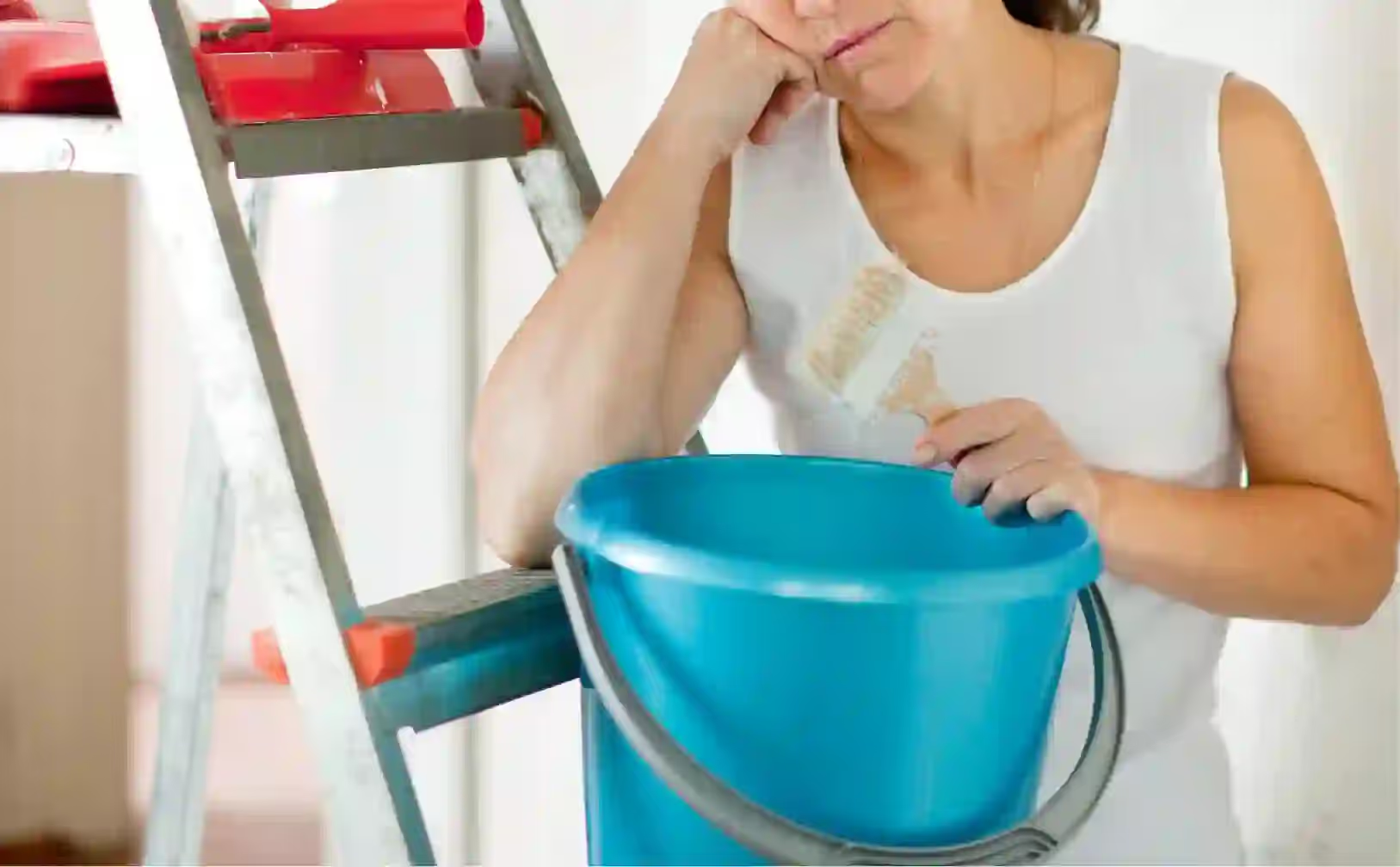
Home identity crisis describes the psychological disorientation that occurs when changes to living space disrupt the sense of belonging, familiarity, and emotional safety that "home" typically provides. The term captures something specific: not dissatisfaction with design decisions or regret about expenditures, but a more fundamental disconnection—the experience of your home feeling like someone else's space.
This crisis exists because homes are not merely physical structures. They're psychological constructs built from accumulated experience, repeated routines, and the countless moments that occur within their walls. The couch where you napped on Sunday afternoons. The kitchen counter where you debriefed the day with your partner. The bathroom mirror where you practiced important conversations. These aren't just locations—they're anchors of identity, places where you learned who you are and how you live.
The American Psychological Association recognizes the profound connection between physical environments and psychological wellbeing. Our surroundings don't just house us—they shape our emotional regulation, our sense of safety, and our capacity for restoration. When those environments change significantly, the psychological foundation they provided must be reconstructed.
The crisis emerges from a collision between expectation and experience. You anticipated that renovation would improve your home—more beautiful, more functional, better suited to your needs. You didn't anticipate that the improved home might feel like a stranger's house. The dissonance between "objectively better" and "subjectively alienating" creates confusion that can be difficult to articulate, especially to others who see only the impressive transformation.
What distinguishes home identity crisis from ordinary adjustment is its depth and duration. Most changes involve temporary discomfort that fades as familiarity builds. Home identity crisis involves more fundamental questioning of the relationship between self and space—a sense that the home no longer reflects or supports who you are, even when its design was explicitly intended to do exactly that.
Understanding why renovation creates emotional disruption requires understanding how humans form bonds with places in the first place. The field of environmental psychology has mapped these processes extensively, revealing that place attachment operates through mechanisms similar to interpersonal attachment.
The Harvard Joint Center for Housing Studies documents how housing quality affects life outcomes across numerous dimensions. But beyond physical quality, the psychological relationship with home affects wellbeing in ways that objective measures don't capture. Two homes with identical features may differ dramatically in how inhabitants feel within them—differences rooted in the attachment bonds that have or haven't formed.
Place attachment develops through time and experience. The first weeks in any new space feel different from the years that follow. Initially, you notice everything—the angle of light, the sounds from outside, the way doors swing. Over time, this awareness fades as the environment becomes background, receding from consciousness into the taken-for-granted infrastructure of daily life. This fading represents attachment formation—the space becoming an extension of self rather than an external object of attention.
Attachment operates through multiple pathways. Functional attachment develops as spaces support repeated activities—the kitchen where cooking happens, the desk where work happens, the bed where sleep happens. These functional associations build predictability that supports cognitive ease. Social attachment develops as spaces host relationships—the dining table where family gathers, the living room where friends visit, the bedroom where intimacy occurs. These social associations build emotional meaning. Autobiographical attachment develops as spaces accumulate memories—the spot where you received important news, the room where a child took first steps, the porch where countless summer evenings passed.
Renovation disrupts all three pathways simultaneously. Functional attachment breaks when spaces no longer support familiar activities in familiar ways. Social attachment strains when the settings of relationship memories transform beyond recognition. Autobiographical attachment suffers when the physical markers of memory disappear.
The newly renovated kitchen may be objectively better for cooking. But it's not the kitchen where you cooked. The continuity between past and present that attachment provides has been severed. The new space must earn its own attachment, which takes time and experience that no amount of design quality accelerates.
Renovation plans typically emphasize function—how spaces will be used, how circulation will flow, how activities will be supported. Identity receives far less attention—how spaces will feel, how they'll reflect inhabitant personality, how they'll express the particular character of this household's life.
When function and identity align, renovations feel like coming home to a better version of yourself. When they conflict, renovations can produce spaces that work well but feel wrong—efficient but alienating, beautiful but cold.
Consider the open-concept renovation that removes walls to create expansive flow. Functionally, the design may succeed: better sight lines, easier entertaining, more light. Identities of household members may respond differently. The introvert who treasured the small enclosed kitchen—a contained space for focused activity—now faces cooking as a performance visible to the entire main floor. The parent who used the separate dining room as workspace when children played in the living room has lost that separation. The teen who valued the privacy of a closed-off space now exists in visual continuity with family activity.
The functional improvement is real. The identity costs are also real. And because the planning process asked "how will you use this space?" rather than "who are you in this space?", the identity costs may not have been anticipated.
When homes become foreign, it's often because renovation has inadvertently changed what the home communicates about its inhabitants. The comfortable clutter that expressed "relaxed and lived-in" has been replaced by clean lines that communicate "designed and intentional." The warm, enclosed spaces that said "cozy retreat" have become open volumes that announce "contemporary sophistication." These communications may be desirable—many homeowners seek exactly these transformations—but they carry identity implications that can take time to integrate.
The experience of foreignness signals misalignment between the space and the self it houses. Sometimes this misalignment resolves as inhabitants grow into the new environment. Sometimes it persists, reflecting a genuine mismatch between design direction and inhabitant identity that planning failed to address. Distinguishing between temporary adjustment and persistent mismatch requires time and attention that the immediate post-renovation period rarely allows.
The psychological journey through renovation follows a recognizable pattern that mirrors change processes in other life domains. Understanding these stages helps normalize experiences that might otherwise feel concerning, and provides a framework for anticipating what comes next.
The decisions required during renovation—hundreds or thousands of individual choices over months or years—create cognitive load that affects emotional capacity. By the time the project completes, many homeowners are too exhausted to feel joy.
Decision fatigue describes the deterioration of decision quality that occurs as the number of decisions increases. Early decisions receive full attention and consideration. Later decisions get made quickly, sometimes defaulting to whatever ends the decision process. The Harvard Joint Center for Housing Studies has examined how decision complexity in housing affects outcomes; renovation amplifies this complexity through the sheer volume of choices required.
The fatigue isn't just cognitive—it's emotional. Every decision carries weight: What if this is wrong? Will I regret this choice? Can I afford to upgrade here? Should I save on this to spend on that? The cumulative anxiety of navigating uncertainty across countless decisions depletes emotional resources.
This depletion affects post-renovation connection. The emotional capacity required to form new attachment to transformed spaces is precisely what decision fatigue has consumed. You arrive at the finish line having used everything you had to get there, with nothing remaining for the work of emotional reacquaintance.
Burnout symptoms in post-renovation homeowners are remarkably consistent. Flat affect when others express admiration for the finished space—you know you should feel proud, but the feeling isn't there. Avoidance of detailed discussion about the project, as if the topic itself is exhausting. Difficulty making decisions about remaining items like furniture placement or accessories—the decision muscle has been overworked. Irritability that seems disproportionate to circumstances—the reserves that normally buffer frustration have been depleted.
Recognizing these symptoms as exhaustion rather than genuine dissatisfaction helps reframe post-renovation confusion. You're not necessarily unhappy with your home—you're depleted by the process of transforming it. The emotional response to the space may be more accurate after rest has restored capacity for genuine response.
Households are emotional systems where the feelings of each member affect the others. When one person struggles with post-renovation adjustment, that struggle ripples through the family. When one person adapts quickly, their ease can support others' adaptation—or can create pressure that makes struggling members feel worse.
The CDC documents connections between housing conditions and mental wellness across populations. Family dynamics within housing environments add another layer—it's not just the physical space that affects wellbeing, but the interpersonal dynamics that occur within that space.
Different household members react to change on different timelines and through different processes. Children may adapt quickly to novel spaces, or may experience profound disruption from the loss of familiar environments depending on age, temperament, and how the transition is managed. Partners may find themselves out of sync—one excited about the transformation while the other mourns what was lost. Extended family visiting the renovated home may respond with enthusiasm that feels invalidating to household members still struggling to adjust.
Emotional contagion—the tendency for emotions to transfer between people in close proximity—means that one person's stress or discontent affects the emotional climate everyone experiences. The partner who loves the renovation may find their enjoyment diminished by awareness of their spouse's struggle. The parent excited about new spaces may feel their excitement dampened by a child's evident discomfort.
These dynamics can create secondary problems beyond the renovation itself. Conflict emerges over whose feelings are valid. Pressure to feel differently than you feel produces resentment. The household that entered renovation with aligned vision may exit with fractured experience that strains relationships.
Acknowledging different adaptation timelines helps reduce this strain. The family member who adjusts quickly isn't betraying the one who adjusts slowly by expressing enjoyment. The family member who struggles isn't failing by needing more time. Making space for different experiences—validating each without requiring convergence—allows household members to process their individual responses without the additional burden of family tension.
Beyond psychological attachment, physical characteristics of renovated spaces can affect wellbeing in ways that aren't immediately obvious. Changes to lighting, acoustics, air quality, and spatial proportions alter the sensory environment you inhabit, sometimes in directions that create subtle but persistent stress.
The EPA provides extensive guidance on indoor air quality, including how construction and new materials can affect the air you breathe. New finishes, paints, adhesives, and manufactured materials can off-gas volatile organic compounds that, while typically within safety limits, may cause subtle symptoms in sensitive individuals—headaches, fatigue, difficulty concentrating, irritability. These symptoms might be attributed to adjustment stress when they're actually environmental response.
Lighting changes can affect mood and circadian rhythms. The warm, somewhat dim lighting of older spaces may have supported evening relaxation in ways that the bright, efficient lighting of renovated spaces doesn't. Alternatively, dramatic improvement in natural light access might be energizing during the day but stimulating in ways that affect sleep.
Acoustic changes matter more than most homeowners anticipate. Removing carpet exposes hard surfaces that reflect rather than absorb sound. Open floor plans eliminate the sound buffering that walls provided. Larger spaces may develop echo or reverberation that makes conversations sound different. These acoustic shifts alter the sensory texture of daily experience in ways that can feel unsettling even when the specific cause isn't identified.
Spatial proportions affect psychological experience in documented ways. Higher ceilings tend to promote abstract thinking; lower ceilings support focused attention. Larger rooms can feel expansive and freeing or exposed and uncontained, depending on individual psychology and context. When renovation changes spatial proportions significantly, the psychological effects may surprise.
Diagnosing environmental factors requires paying attention to physical symptoms and their patterns. Do you feel better in some rooms than others? Do symptoms emerge at particular times of day? Do you feel differently when windows are open versus closed? These patterns can help distinguish environmental effects from purely psychological adjustment.

If home identity crisis arises from misalignment between space and self, preventing it requires designing for emotional alignment from the start. This means considering how spaces will feel, not just how they'll look or function.
Space zoning acknowledges that different activities and moods require different environments. A home that consists entirely of open, bright, energetic space doesn't serve the need for retreat, quiet, and restoration. Designing should include spaces that support high energy and spaces that support low energy, spaces for social engagement and spaces for solitary retreat, spaces that stimulate and spaces that calm.
Quiet corners—small, contained spaces that feel protected—support emotional regulation in ways that open expansive spaces don't. Including such spaces in renovation plans provides options for psychological states that open plans don't serve. The reading nook, the window seat, the alcove that feels enclosed—these aren't design afterthoughts but essential provisions for emotional wellbeing.
Adaptable design creates spaces that can shift with changing needs rather than locking in single uses. The room that serves as home office can become guest room or hobby space as needs evolve. The open living area can be partially divided when privacy needs increase. This adaptability provides insurance against future identity mismatches.
Familiar elements intentionally retained within renovated contexts provide continuity that supports attachment. The antique piece that remains when everything else changes. The artwork that anchors memory across transformations. The color palette that extends from old to new. These continuity elements ease the psychological transition that wholesale change makes harder.
Evidence from residential behavioral research suggests that inhabitant involvement in design decisions improves post-occupancy satisfaction—not just because preferred choices were made, but because the process of engagement builds psychological ownership before physical completion. Renovation processes that treat homeowners as passive recipients of designer vision may produce beautiful spaces that don't feel like home. Processes that involve homeowners as genuine participants build connection through participation.
Individual experiences illustrate how home identity crisis manifests and resolves across different situations.
A couple in their forties undertook a comprehensive modernization of their 1970s colonial, transforming its compartmentalized layout into an open contemporary space. The renovation was technically excellent. The result impressed visitors and significantly increased the home's value.
But the couple found themselves oddly unhappy. The wife, who had loved her small separate kitchen, felt exposed cooking in the open layout. The husband, who had retreated to the den for work calls, no longer had enclosed space for professional conversation. Both missed the definition that walls had provided—the rooms that were clearly for specific purposes, the separation that allowed parallel activities without mutual disruption.
Their reconciliation came through strategic modification. A large bookshelf created visual separation between living and dining areas without rebuilding walls. A pocket door was added to create a closeable home office. Comfortable seating arrangements created zones within the open space that felt distinct. These adjustments preserved the renovation's benefits while addressing the identity costs its original design hadn't anticipated.
A senior homeowner in her seventies renovated a bathroom for accessibility as mobility declined. The renovation replaced her vintage bathroom—original fixtures, familiar tile, the same space she'd used for thirty years—with a modern accessible design. Functionally, the renovation was essential and successful.
Emotionally, she felt displaced. The bathroom that had been hers was gone. The new bathroom, though necessary, belonged to "someone who needed all this." The handrails and walk-in shower, rather than supporting independence, served as constant reminders of decline. She avoided using the renovated bathroom when guests were present, as if it revealed something about her she didn't want seen.
Her adaptation came through reframing and personalization. She began choosing to use the accessibility features rather than experiencing them as impositions—the shower seat became "where I enjoy my long hot showers" rather than "what I need because I can't stand." She added personal elements that hadn't been in the original plan—artwork she loved, decorative towels, a small plant. Over months, the bathroom became hers through use and accumulation, its functional nature receding as personal meaning built.
A family with young children renovated their entire main floor, creating the open, light-filled, family-centered space that countless families seek. Unlike the previous cases, their adjustment was swift and satisfying. Within weeks, the new space felt like home.
Their successful transition reflected several factors. They had been intensely involved in the design process, making decisions with full understanding of trade-offs. They moved in with low furniture inventory, allowing space to suggest its own arrangements rather than imposing prior patterns. They immediately began creating new routines—the breakfast spot, the homework table, the play area—that built fresh associations. Most importantly, they entered with realistic expectations, understanding that adjustment would take time and that initial ambivalence was normal rather than concerning.
Recognizing home identity crisis enables addressing it rather than suffering through unnamed confusion. These indicators suggest that post-renovation experience may involve identity disruption rather than ordinary adjustment.
These indicators warrant attention rather than dismissal. Home identity crisis is real, common, and addressable—but only if recognized rather than denied.
The National Association of the Remodeling Industry (NARI) promotes professional standards that include attention to client experience, not just project execution. Contractors and designers who understand emotional dimensions of renovation can help clients navigate identity transitions that less aware professionals might inadvertently worsen.
The professional's role in emotional planning begins with questions that go beyond function and aesthetics. Not just "how will you use this space?" but "how do you want to feel in this space?" Not just "what style do you prefer?" but "what makes a space feel like home to you?" These questions surface emotional requirements that purely practical planning misses.
Warning signs of professionals who may not support emotional planning include dismissal of attachment to existing spaces ("you won't miss it once it's gone"), pressure toward trendy choices that don't align with client lifestyle, impatience with decision-making time that clients need, and framing of client hesitation as obstacle rather than information.
Questions to ask professionals before signing contracts include how they approach helping clients through the emotional transition of renovation, what they do when clients express uncertainty about significant changes, how they balance their professional design judgment against client preferences that might differ, and whether they can describe a project where they helped a client through post-renovation adjustment challenges.
Professionals who engage thoughtfully with these questions likely bring emotional intelligence to their practice. Professionals who seem confused by or dismissive of these questions may deliver excellent technical results while overlooking the psychological dimensions that determine whether clients actually enjoy living with those results.
Your home reflects who you are. It also shapes who you become. This reciprocal relationship means that changing your home changes you—not just your address or your equity, but your daily experience of being yourself in the world.
Renovation disrupts this reflection and containment. The mirror shows an unfamiliar image. The container no longer fits the familiar contours of daily life. The disorientation that results isn't weakness or ingratitude—it's appropriate response to significant change in the environment that supports identity.
Home identity crisis, when it occurs, is not permanent unless it's ignored. Given acknowledgment, time, and intentional reacquaintance, connection to transformed space can be rebuilt. The new space can become home—not the old home recreated, but genuine new home that holds the life you're living now.
If you're struggling with post-renovation disconnection, know that your experience is common and your feelings are valid. The beautiful space that doesn't feel like yours yet can become yours through the accumulation of experience, the building of memory, and the deliberate creation of meaning that no contractor can install but that you can create through living.
The spaces we inhabit matter. They're not just backdrop—they're participants in our lives. Treating renovation as purely physical transformation misses the psychological dimensions that determine whether the result truly serves. Attending to those dimensions—before, during, and after the construction dust settles—enables renovation that doesn't just change your house but supports your ongoing journey of being at home in the world.
DECEMBER 01, 2025
DECEMBER 01, 2025
DECEMBER 01, 2025
DECEMBER 01, 2025